
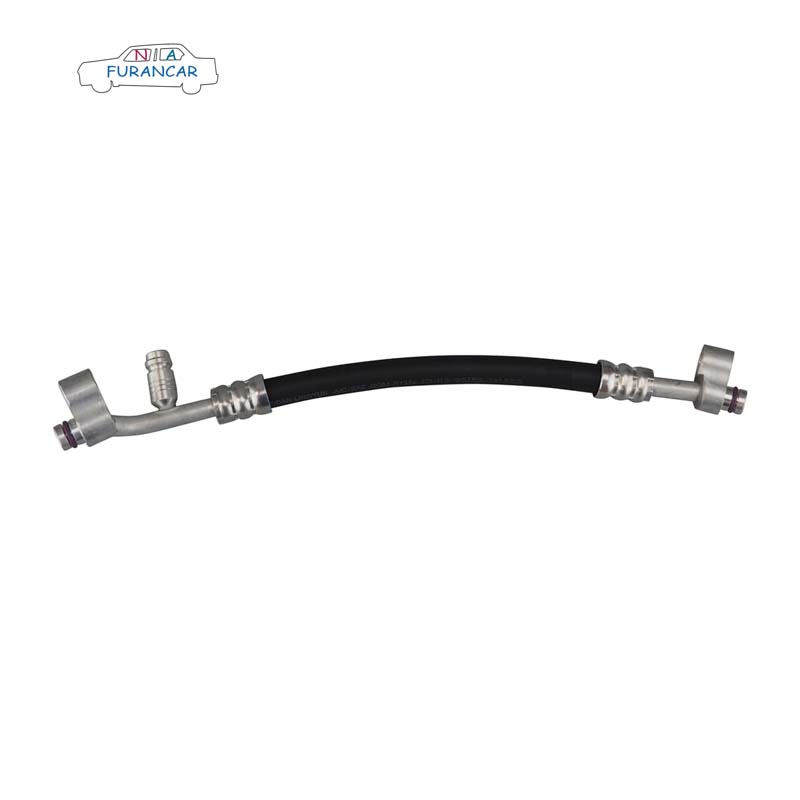
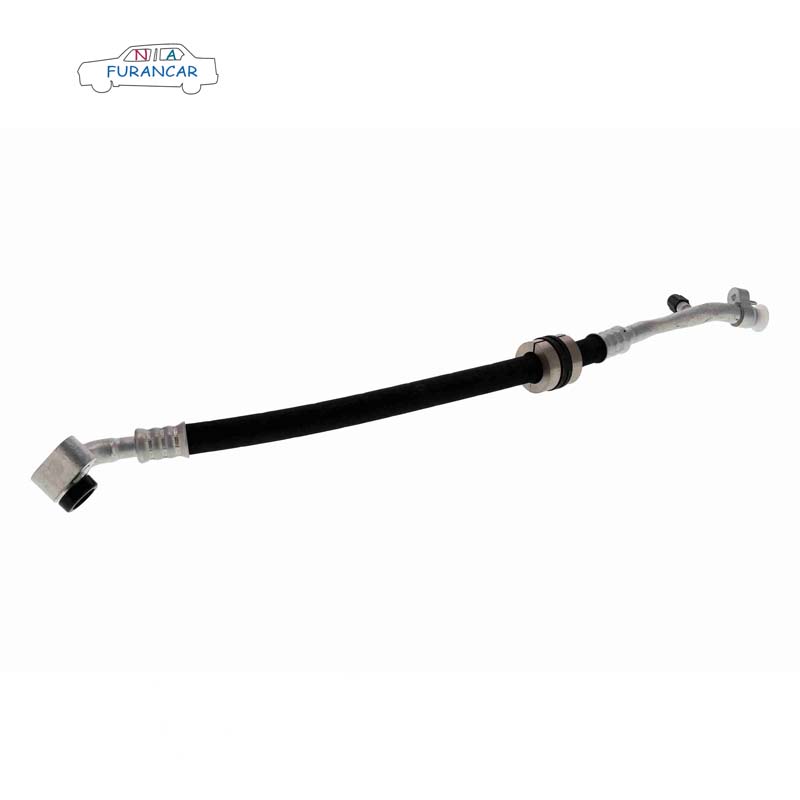
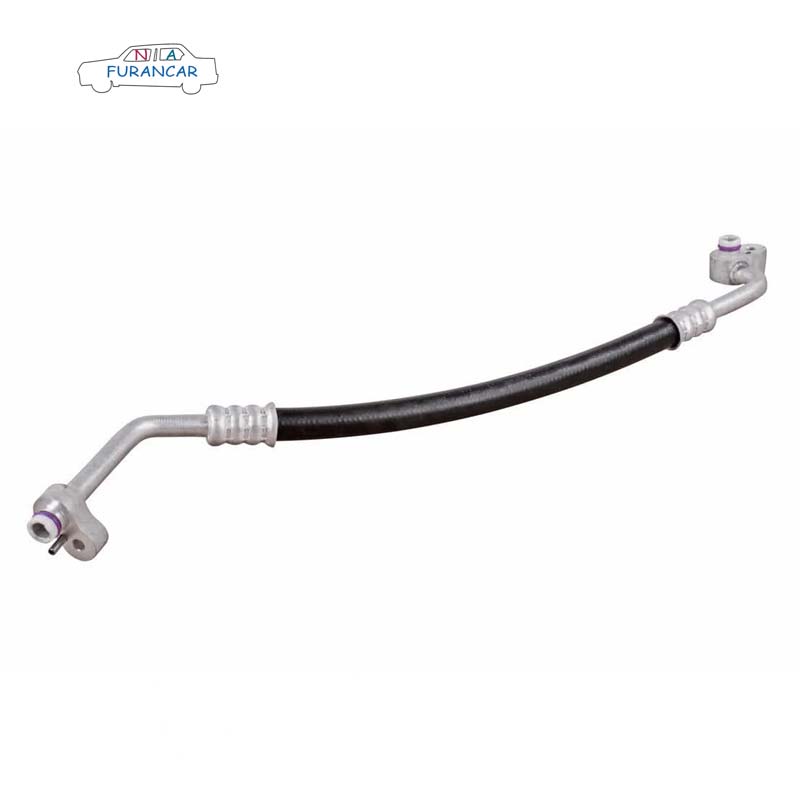
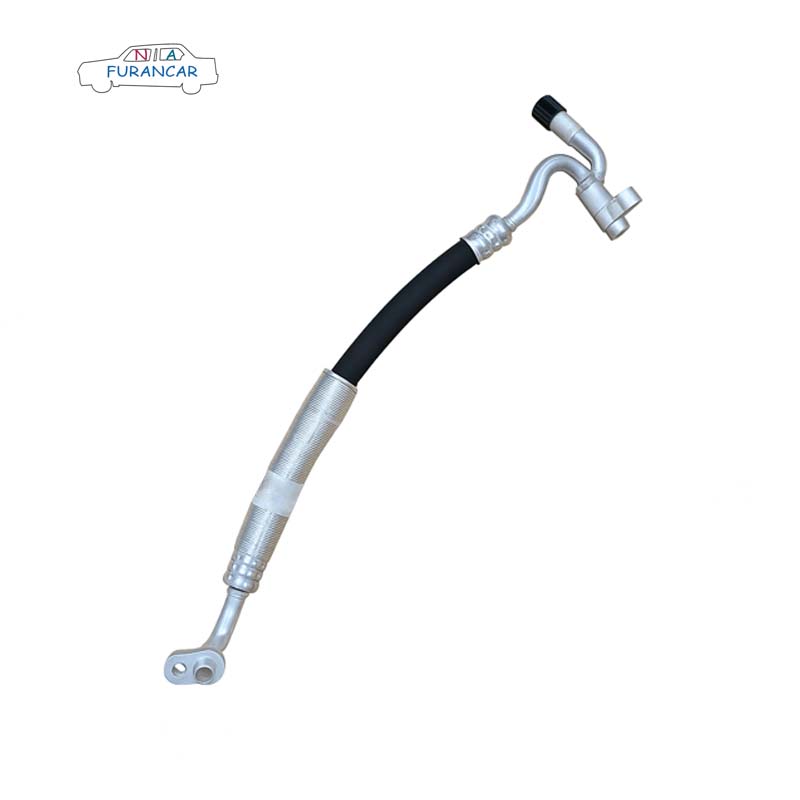
Automotive air conditioning refrigerant hoses are the core flexible fluid-transfer components within the vehicle’s air conditioning refrigeration circuit. Specifically, they refer to specialised hose assemblies manufactured using a multi-layer composite structure, designed to transfer refrigerant and associated refrigeration oil in a sealed manner between key components of the vehicle’s air conditioning system—such as the compressor, condenser, expansion valve and evaporator—whilst being capable of withstanding the demands of vehicle operation.
What are the main tests that are routinely carried out?
Joint pull-off strength test
Definition: A test to determine the connection strength between a hose and a coupling, and to assess whether the coupling will pull out of the hose under axial tensile force.
Principle: Axial tensile force is applied to the hose assembly at a rate of 25 mm/min ± 2 mm/min; the load value at the point of separation is recorded to verify the mechanical reliability of the connection.
Burst pressure test
Definition: A destructive test in which pressure is applied at a constant rate within a specified time frame until the hose ruptures, in order to determine its maximum pressure rating.
Principle: By applying pressure to a liquid, this test simulates the instantaneous high pressures that a hose may be subjected to under extreme operating conditions (such as system blockages or compressor malfunctions), thereby verifying the safety of the material strength and structural design.
Dielectric strength test
Definition: A test to assess the hose’s sealing performance and structural stability under long-term operating pressure, involving maintaining a pressure of 50% of the burst pressure for 2 minutes.
Principle: By subjecting the hose to sustained pressure, the test detects any minor leaks or structural deformation, thereby verifying its long-term reliability under normal operating pressure.
High-temperature resistance test
Definition: A test to evaluate the thermal stability and sealing performance of materials at high temperatures by placing hoses in a constant-temperature environment of 80°C to 100°C (100°C for high-pressure hoses and 80°C for low-pressure hoses).
Principle: This test simulates the effects of the high-temperature environment in the engine compartment (which can exceed 120°C) on hoses, to determine whether the rubber material softens, ages or undergoes dimensional changes, and whether the seals at the joints fail.
Low-temperature resistance test
Definition: A test to assess the material’s flexibility and resistance to embrittlement at low temperatures, in which the hose is placed in an environment of -40°C for 70 hours, by a bending test.
Principle: Low temperatures cause rubber materials to harden and become brittle. By subjecting the hose to bending (with a bending radius of five times the outer diameter), the test checks for cracks or breaks, thereby verifying its suitability for use in cold regions (such as the Northeast or Siberia).
Vacuum resistance test
Definition: A test to evaluate the structural stability and sealing performance of a hose under vacuum conditions, conducted by evacuating the hose to a vacuum of 1.33 kPa (absolute pressure) and maintaining this condition for 24 hours.
Principle: This test simulates the vacuum conditions that may occur on the evaporator side (low-pressure side) of an air-conditioning system to determine whether the hose collapses or leaks due to the difference in internal and external pressure.
Ozone resistance test
Definition: An accelerated ageing test in which a bent hose is placed in an environment of 40°C and an ozone partial pressure of 50 MPa for 70 hours, to assess the rubber material’s resistance to ozone ageing. Principle: Ozone reacts with the unsaturated bonds in the rubber, causing surface cracking; this accelerated test simulates the ozone attack that the hose might encounter in an outdoor environment.
Pulse fatigue test
Definition: A durability test in which a hose is subjected to cyclic pulsating pressure of (0.5–3.5) MPa (for high-pressure hoses) or (0.5–2.6) MPa (for low-pressure hoses) at a frequency of 30–40 cycles per minute, for a total of 150,000 cycles, in an environment of 125°C.
Principle: This test simulates the pressure fluctuations caused by engine vibrations and road surface irregularities during vehicle operation, in order to assess the fatigue resistance of the hose material and the reliability of the joint seal.
Refrigerant Permeability Test
Definition: A test conducted at temperatures between 80°C and 100°C to measure the rate at which refrigerant permeates per unit area of hose per unit time, thereby assessing the material’s barrier performance.
Principle: Using the mass loss method, this test determines whether refrigerant permeates through the molecular gaps in the rubber material, thereby verifying the effectiveness of the hose’s barrier layer (e.g. the PA nylon layer).
Test for extractable substances
Definition: A test to determine the concentration of substances that may leach from the inner surface material of a hose when exposed to refrigerant, and to assess the compatibility of the material with the refrigerant.
Principle: By cleaning with iso-octane and immersing in refrigerant, any additives, residual solvents or other substances that may be present on the inner surface of the hose are extracted, thereby preventing these substances from entering the air-conditioning system and affecting compressor lubrication or causing blockages in the expansion valve.
Test for the rate of volume change of the inner layer material
Definition: A test in which the inner rubber layer of a hose is immersed in a refrigerant, held at 100°C for 70 hours, and the rate of volume change is measured to assess the material’s compatibility with the refrigerant.
Principle: To determine whether the rubber material swells (increases in volume) or shrinks under prolonged exposure to the refrigerant, thereby verifying the suitability of the material formulation.
Bending strength test
Definition: A test conducted at ambient or low temperatures to measure the force required to bend a hose through 90°, thereby assessing the material’s flexibility and the soundness of the structural design. Principle: By subjecting the hose to bending, this test determines whether it bends easily during installation and use, whilst also verifying the material’s resistance to cracking under bending stress.
Test for the rate of change in length
Definition: The length variation test involves subjecting automotive air-conditioning refrigerant hoses to specific environmental conditions, measuring the difference in length before and after the test, calculating the percentage change in length, and assessing the dimensional stability of the hose material under simulated service conditions.
Principle: Temperature fluctuations cause materials such as rubber and reinforcing layers to expand and contract; refrigerant and compressor oil may penetrate the rubber material, causing it to swell or shrink, which in turn leads to changes in the hose’s length.
Internal surface cleanliness test
Definition: An internal surface cleanliness test is a procedure in which soluble impurities and insoluble particles adhering to the inner surface of automotive air-conditioning refrigerant hoses are extracted using methods such as solvent extraction and filtration, by quantitative analysis of the impurities to assess whether the cleanliness of the hose’s inner surface meets the system’s operational requirements. Principle: The test simulates the contact between the inner surface of the hose and the refrigerant/refrigeration oil. A specific solvent is used to thoroughly clean the inner wall of the hose, transferring all impurities into the solvent. The total amount of impurities and the particle size distribution are then quantified through filtration, drying, weighing or particle counting to verify whether they fall within the limits permitted by the standard, thereby preventing impurity contamination of the system at source.


 Whatsapp :
  Tel :
Tel :  Email :