
The automotive market is becoming increasingly competitive, with the air conditioning system representing a crucial component of the vehicle. Within this system, the piping network constitutes an indispensable element of its development, serving to facilitate the circulation between the blower and compressor, as well as between the evaporator and engine. This article primarily outlines the development process of automotive air conditioning piping.
The air conditioning system constitutes a vital component within a motor vehicle, primarily serving to provide a comfortable cabin environment by delivering warm air during winter months and cool air during summer. Typically, a vehicle's air conditioning system comprises a compressor, an electronically controlled clutch, a condenser, a blower fan, a receiver-drier, refrigerant piping, an evaporator, an expansion valve, and refrigerant. In new energy vehicles, it may additionally incorporate critical components such as a battery cooler, whose principal function is to dissipate heat from the battery pack. The air conditioning compressor serves as the system's ‘heart’, elevating the refrigerant pressure within the piping to facilitate its liquefaction and heat dissipation within the condenser, whilst also circulating the refrigerant throughout the system. The refrigerant's circulation within the system continuously absorbs heat from the cabin air, achieving cooling within the vehicle. Each refrigerant cycle comprises four processes: compression, condensation, throttling, and evaporation, as illustrated in Figure 1. Heating in the air conditioning system is primarily achieved through engine heat (in petrol vehicles) or a PTC thermistor-type heating system.
Air conditioning refrigerants serve as the working medium within the refrigeration cycle, achieving cooling through phase changes that facilitate heat exchange. With heightened environmental awareness, our company currently employs two primary refrigerants: R134a and R1234YF. R1234YF is an automotive air conditioning refrigerant that exhibits zero ozone depletion potential and a low global warming potential (GWP). It complies with EU automotive air conditioning regulations and is typically utilised in vehicle models exported to the European Union. However, R1234YF carries a higher cost and is classified as a hazardous and explosive substance.
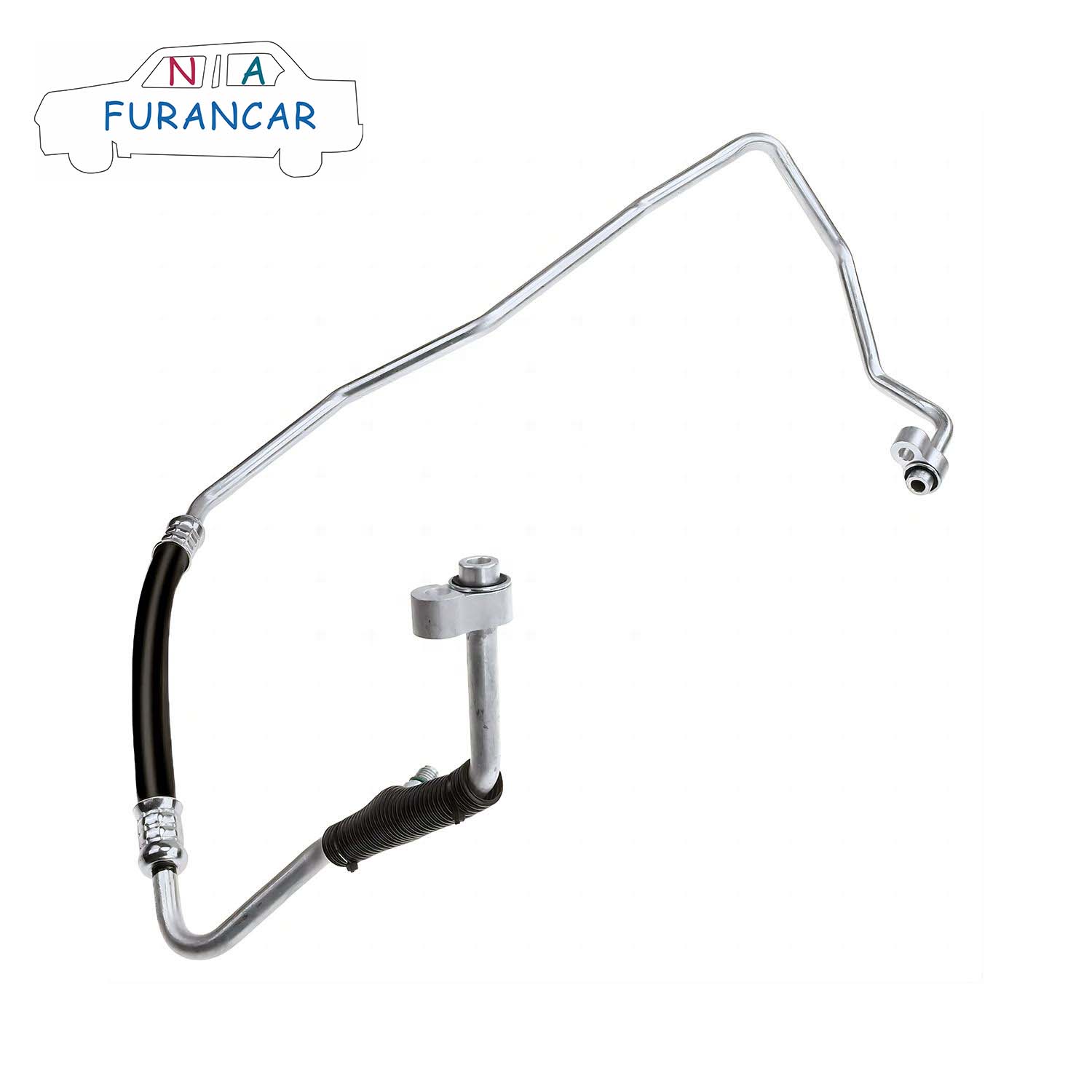
Air conditioning piping connects components such as the compressor, condenser, evaporator, and expansion valve, forming a closed system through which the refrigerant circulates. A typical air conditioning system comprises three main pipes: the compressor suction pipe, the discharge pipe, and the condenser discharge pipe. Air conditioning piping may be categorised by material into copper tubing, aluminium tubing, and rubber hoses; by pressure into high-pressure lines and low-pressure lines; and by refrigerant state into gas lines and liquid lines. Automotive air conditioning piping primarily comprises aluminium tubing, fittings (clamps, connectors, nuts, etc.), air conditioning rubber hoses, air conditioning corrugated tubing, charging ports, and O-rings.
There are various types of connectors for automotive air conditioning lines, with threaded connections and clamp-on connections being two of the more common methods.
Where pipelines run parallel to one another in pairs, weld nut holes shall be designed at suitable positions on the front enclosure outer panel. Pipelines shall be secured using multiple pipe clamps, with fixed mounting points spaced at 300mm intervals. Figure 3 illustrates a high-low pressure pipe assembly employing dual pipe clamps.
The securing of the pipes requires the use of cable ties for assistance, as shown in Figure 3. Specific air conditioning drain pipes are secured to the heating water inlet and outlet pipe assemblies using cable ties, serving to anchor and stabilise the installation.
The processing workflow for piping components is as follows: Cutting to length, deburring and rounding edges, turning ends, end machining, turning grooves, chamfering and deburring, inspecting end dimensions, bending, drilling, inspecting bend dimensions, pre-weld cleaning, fitting nuts, welding pressure plate valve seats, weld inspection, post-weld cleaning, inspecting cleaning results, fitting valve cores, marking, fitting O-rings, placing in plastic bags, Hose cutting, aluminium sleeve assembly, crimping, bellows cutting, bellows fitting, aluminium sleeve assembly, crimping, airtightness inspection, overall inspection. Ensure the airtightness of processed piping meets design requirements.
Air conditioning piping must undergo the following tests and achieve satisfactory results before being put into service.
1.Leak test: Seal one end of the hose assembly, connect the other end to a quick-release sealing coupling, and charge the system with dry nitrogen at a pressure of 3–3.2 MPa via the coupling. Immerse the assembly in a water bath for 30–60 seconds. The test is considered satisfactory if no bubbles are observed.
2.High-Temperature Resistance Test: Bend the hose assembly around a mandrel with a diameter eight times the hose's nominal outer diameter. Place it in a constant-temperature chamber at (135±2)°C for 168 hours. Remove the sample, cool to room temperature, release the hose, and meticulously inspect the outer surface for visible defects such as cracks. Subsequently, pressurise the hose assembly to 2.4 MPa and maintain for 5 minutes. Check for leakage; absence of leakage constitutes a pass.
3.Pull-off Test: Take two hose assemblies with exposed hose lengths of no less than 300 mm. Secure both ends to a tensile testing machine and apply tensile force at a rate of (25±2) mm/min until the specified minimum pull-off force is reached or the hose is pulled off to failure. The pull-off force shall meet the following requirements: - For hoses with a nominal diameter less than 10 mm: minimum pull-off force of 1,800 N - For hoses with a diameter between 10 and 12 mm: minimum pull-off force of 2,500 N - For hoses with a diameter greater than 13 mm: minimum pull-off force of 2,700 N.
4.Burst test: Mount the hose assembly on a pressure test bench. Fill the interior with coolant, expel all air, then pressurise uniformly to 12 MPa within 30–60 seconds. Observe for leakage or damage; if none occurs, the test is passed.


 Whatsapp :
  Tel :
Tel :  Email :